
Biocracy: The Feedback Latency Playbook
Core Idea: Living Governance Through Fast Feedback
A biocracy lives or dies by how quickly it learns. In every living system—from a single cell to an ecosystem—survival depends on the speed of sensing and correcting errors. The same applies to societies. In governance, feedback latency is the time it takes to turn a citizen signal into a policy response. The shorter this loop, the more adaptive, fair, and trustworthy the system becomes.
Why Feedback Latency Matters
When feedback moves slowly, systems drift, resources are wasted, and trust erodes. When feedback loops are fast, errors are small, and adaptation is continuous. Biocracy doesn’t chase perfection—it optimises for correction. It treats every policy as a living process, designed to evolve.
In short: Long delays breed decay. Short loops breed life.
Quick Diagnostic: Five Key Questions
Choose any policy or program and ask:
Signals – How do we sense reality weekly (not yearly)?
Visibility – Who sees the data first: frontline workers or central offices?
Agency – Who has authority to make adjustments?
Speed – How long does it take from insight to action?
Reflection – How quickly do we learn if the change worked?
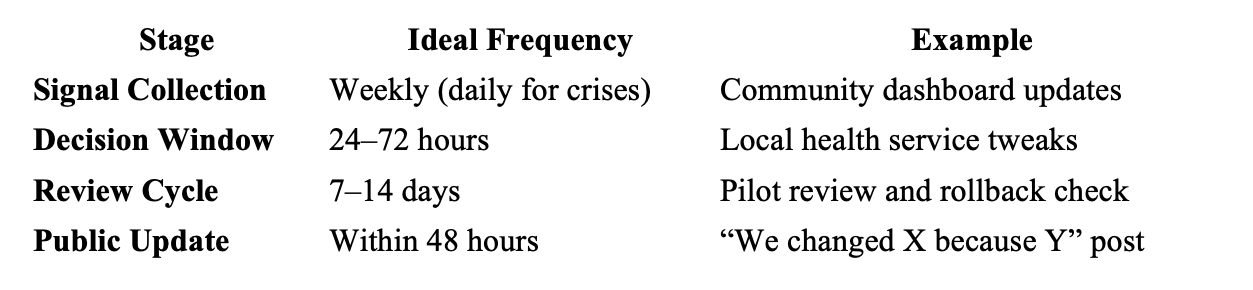
Target Benchmarks
Biocracy Tools
Citizen Sensors • Rolling micro-surveys (2–3 questions) for live sentiment
Safe-to-Fail Pilots • Micro-experiments with rollback triggers
Delegated Knobs • Local authorities empowered to act fast within clear limits
Latency Boards • Public dashboards showing real-time response times
Post-Adjust Notes • Transparent updates on what changed, why, and what happens next
These tools turn feedback into fuel. They help governments act less like bureaucracies and more like living organisms—sensing, learning, and self-correcting in real time.
Visual Summary: The Living Loop
Signal → Sense → Adjust → Reflect → Share → Signal again.
This cycle is the heartbeat of biocracy. Every iteration strengthens collective intelligence.
Guiding Principle
The shortest honest loop wins.
Measure the time from signal to response. Halve it. Then halve it again. That’s how living governance grows.
Next Steps
For local councils, NGOs, or organisations interested in piloting biocratic feedback systems:
Start with one measurable issue (e.g. waste management, healthcare access).
Map your current feedback latency.
Implement one quick-loop tool.
Track how response time changes.
Every loop teaches the system to learn faster.