How Biocracy Works
A living architecture for a learning society
Biocracy translates the principles of life — Regeneration, Cooperation, and Learning — into the design of government itself.
Instead of fixed hierarchies and slow, centralised control, Biocracy builds systems that sense, respond, and evolve.
Where democracy was humanity’s first great experiment in distributed power, Biocracy is its evolution — democracy redesigned for a living planet.
The Triadic Model – Governance that Breathes
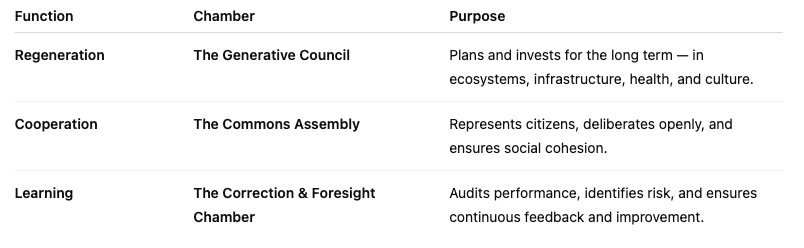
In place of the traditional three branches of government — legislative, executive, and judicial — Biocracy creates three living chambers that mirror life’s core functions:
Each chamber is independent but interconnected — like organs in a living body.
Power flows between them, not above them, creating a circular system of action, reflection, and renewal.
A Biocracy doesn’t just act — it listens, adjusts, and learns.
The Generative Council – Investing in the Future
The Generative Council ensures that society always produces more vitality than it consumes.
It focuses on long-term regeneration: renewable energy, ecosystem restoration, cultural creativity, public health, and innovation.
Guided by the Biotropy Index, it measures progress by life-sustaining capacity, not by economic growth alone.
It allocates resources through Triadic Budgeting, balancing renewal, social cohesion, and oversight.
Its members are drawn from citizens, scientists, and community leaders — combining expertise with accountability.
The role of governance is not to predict the future, but to keep the future possible.
The Commons Assembly – Democracy Evolved
The Commons Assembly is the voice and memory of the people.
It combines elected representatives with citizens chosen by sortition — ensuring both experience and diversity in decision-making.
All deliberations are public and transparent.
Citizens contribute through participatory platforms, digital town halls, and local assemblies.
Policies are debated not behind closed doors but in open dialogue guided by evidence and empathy.
The Assembly replaces representation-as-spectatorship with representation-as-participation.
It transforms democracy from a periodic event into a continuous conversation.
The Correction & Foresight Chamber – Learning as Integrity
Every living system needs an immune system — a way to detect and repair harm before collapse.
The Correction & Foresight Chamber performs that role in Biocracy.
It evaluates the impact of policies after implementation.
It reviews data, audits outcomes, and identifies early signs of crisis.
It maintains a Foresight Docket tracking long-term risks — from climate tipping points to emerging technologies.
Half of its members are citizens, half independent experts.
It represents wisdom, not authority — ensuring that governance remains honest, transparent, and capable of reflection.
Correction is not punishment; it is compassion for truth.
The Executive Secretariat – Coordination Without Control
Instead of a single leader or cabinet, Biocracy has a lean Executive Secretariat — a coordination body drawn equally from the three chambers.
Its purpose is to connect, not command.
It translates the chambers’ decisions into action, manages logistics, and ensures that information moves swiftly through the system.
In crises, it activates Emergency Response Hubs — decentralised teams that act quickly and dissolve when the danger passes.
Every decision is logged publicly, reviewed after the fact, and subject to automatic expiry unless renewed.
Power in Biocracy is temporary and transparent.
The Executive’s strength lies not in control, but in responsiveness.
Triadic Budgeting – The Circulation of Resources
Like blood in a body, resources must circulate to keep the system alive.
Biocracy uses Triadic Budgeting — dividing national investment into three complementary funds:
The Regenerative Fund – supports ecological restoration, education, culture, and innovation.
The Cohesion Fund – sustains health, inclusion, and social equity.
The Learning Fund – funds audits, foresight, and continuous improvement.
Budgets are hypotheses, not decrees.
They are reviewed through feedback data and adjusted as evidence accumulates.
A healthy system flows; a rigid one decays.
Feedback as Law
In Biocracy, feedback is not optional — it’s constitutional.
All institutions must measure and publish their Feedback Latency: the time between a citizen signal and a policy response.
Shorter loops mean greater trust.
Public data is treated as a shared commons, open for scrutiny, annotation, and reinterpretation.
The Right to Reasons guarantees that citizens can always ask why a decision was made — and expect an answer.
Transparency is not a virtue; it’s the nervous system of democracy.
Resilience and Learning
When crises strike — fire, flood, disease, or digital threat — Biocracy contracts to protect and expands to share.
Emergency powers are temporary, audited, and followed by public learning reviews.
Resilience is measured not by avoiding shocks, but by how swiftly the system learns from them.
In crisis, power breathes in; in recovery, it breathes out.
A Government That Evolves
Biocracy is designed to change.
Every chamber, council, and law includes built-in review cycles — the ability to correct and evolve without violence or upheaval.
The Constitution itself is reviewed every decade, ensuring it grows with the knowledge and conscience of the society it serves.
A living system survives by staying adaptable.
A living government does the same.
Biocracy is not the end of politics — it is politics that can learn.